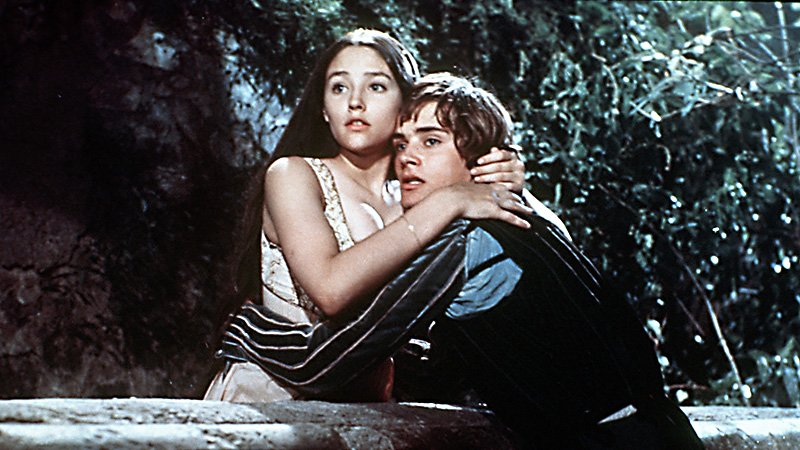
Logan-Rogersville Junior High, Rogersville, Missouri, sometime in late 1968 or early 1969. A substitute English teacher convinced the principal to bus her ninth-graders 20 miles into Springfield to see a scandalous movie. Why? Because it’s Romeo and Juliet, the most famous English writer’s most famous play. A once-in-a-lifetime opportunity for many of us. How did she do it? Unknown. I’m pretty sure she was a sub, because who else but a short-timer would put such a plan forward to a conservative school admin, just to give a herd of farm kids a taste of high art? But there was a catch. We had to promise the teacher we would be on best behavior. And we could go only if our parents signed a consent. Most kids got approval. A few didn’t.
But wait. Did I say “scandalous” movie? William Shakespeare? Well, all most of us knew was that it had nudity. Not much, but it didn’t take much to be judged dangerous back then. I remember my mom hesitating to sign the approval because of it. My dad shrugged it off.
We had to watch a lot of scenes and try to decode a lot of weird dialog before the, ahem, big reveal. But … what’s this? Romeo’s bare bum. A few twitters from the guys. The teacher barked at us. Maybe that’s why some of us missed a quick, partial glance at Juliet’s breasts. A letdown, regardless. As hard as it was to read Shakespeare’s dialog, I’d hoped a movie would be easier to understand. Nope. Through high school, being assigned Shakespeare felt like punishment.
In my first year of college, having signed up for basic ed classes, I felt I needed at least one English-majorish selection. Why not swallow the bitter pill first? A semester of Shakespeare, covering his poetry and comedies. With the tutelage of a professor who no doubt knew more about the richness of Shakespeare than that long-forgotten sub, I found there was much to admire. So the following semester I signed up for a semester of his histories and tragedies. And I emerged as a full-on admirer of his plays and sonnets, more so perhaps for the sheer brilliant energy of his language as the complexity of his characterizations and plotting.
Close to six decades after my first exposure, I gave Franco Zeffirelli’s Romeo and Juliet another try. It’s my favorite rendition, though somewhat by default given its anemic competition, exemplified by Baz Luhrmann’s overblown and self-indulgent 1996 tragedy (yeah, that’s a pun).
Is there anyone who doesn’t know the basic plot line of Shakespeare’s most performed play? Even if you skipped reading it in school, it’s discussed everywhere. Still, to avoid spoilers, let’s give away this much: The scene is Verona, Italy. Though his family is the sworn enemy of the Capulet clan, Romeo Montague (Leonard Whiting) ill-advisedly sneaks into their masquerade ball. There, we witness perhaps the first-ever scripted meet cute. From across the ballroom he spies Juliet Capulet (Olivia Hussey). He gets nearer. They meet. They instantly fall in love. That evening, Romeo sneaks into Capulet territory to woo Juliet at her balcony. Even if you’ve never seen the play performed, you know the key lines. Romeo’s “Hark, what light through yonder window breaks” and Juliet’s “Romeo, Romeo, wherefore art thou Romeo?” (English-major note here. She’s not asking where he is. “Wherefore” meant “why” back then, so she’s basically lamenting “why did the love of my life turn out to be a Montague”).
The two fall so deeply in love that they marry secretly the next day, with Juliet’s nurse (Pat Heywood) sneaking her young charge out of the house and Friar Laurence (Milo O’Shea) performing the nuptials.
Ah, but the worst of luck. The next day, in a dustup in the town square, Juliet’s cousin Tybalt (Michael York) kills Romeo’s best friend, Mercutio (John McEnery). An enraged Romeo pursues and kills Tybalt. Romeo is banished from Verona, on pain of death should he return. He and Juliet covertly spend their wedding night together, with the morning sun rising on that scandalous scene which, by our standards some 60 years on, now earns it a PG rating.
The two lovers cannot wait for time to heal the family divisions. Faced with a forced marriage, Juliet agrees to the friar’s carefully designed scheme to reunite the lovers and let them escape into a happy ending. But as you know, Romeo and Juliet is a tragedy. The plans go awry. As the ending credits are about to roll, the narrator (the venerable Laurence Olivier) intones:
A glooming peace this morning with it brings;
The sun, for sorrow, will not show his head.
Go hence to have more talk of these sad things;
Some shall be pardoned, and some punished.
For never was a story of more woe
Than this of Juliet and her Romeo.
See It
Although in his day Shakespeare could have never staged Romeo and Juliet as Zeffirelli does, I wonder if, in its raucous enthusiasm and often exaggerated acting, it would be a better fit for a rowdy Elizabethan crowd than the sedate, courtly performances of other movies.
The two young leads, Leonard Whiting and Olivia Hussey, are actually quite good. Their awkward, sometimes too ardent performances, seem right for teenagers in the throes of their first love.
The real delight is Pat Heywood, the nurse who conspires with her young charge so she can marry her Romeo. She is feisty, opinionated, and cantankerous. We even forgive her when the circumstances of Romeo’s banishment cause her to change her mind.
Another standout: that moment when Mercutio (John McEnery) gives the famous Queen Mab speech. Honestly, I find it hard to parse as McEnery winds his way through Shakespeare’s tale of a fairy who rides through the minds of sleepers. McEnry perfectly transitions from the initial playful and mocking tone, to the dark and cynical conclusion. Just by the intensity of his monologue and his movements, we appreciate the mastery of the performance.
So … about my recommendation. It doesn’t matter to you, does it? You made up your mind years ago about watching Shakespeare plays. If you like them, Zeffirelli’s Romeo and Juliet is definitely worth adding to your watch list. If Shakespeare is painful to you, then no amount of my urging will change your mind.
Did I enjoy this version? Yes. The costuming is consistently beguiling, from the wildly colored clothes of the men in the streets, to the women’s gowns and frocks and the men’s suits. The soundtrack? Famous. Though it won’t show up on any list of my favorite movies, I am glad to be able to add it, so long after my initial teenage viewing, to my diary of Shakespeare classics. Like the The Bard himself, whom I admire more for his brilliant language than his stories, I admire this movie more for its unapologetic zest and verve than for any emotional response this all-too-familiar tale evoked.