Note: Because this documentary doesn’t have the type of plot one can spoil, and because I know a tad more than usual about the subject, this is more of an essay than a typical review, as I venture comprehensively into details and insights. If you plan to watch Queen of Chess, best do it now before reading further.
Circa 1983, back home on a rare break from my job as editor of Chess Life magazine, I dropped in on my grandma and found her, surprisingly, watching tennis on TV. I said something like, “Who’s winning?” And she said something like, “I don’t know. I guess I’d enjoy this more if I knew all the rules.”
And it hit me. In the chess world of 1983, I was tasked with expanding the visibility of the royal game. But surely not by trying to explain its rules and nuances to non-players? Anyone could enjoy tennis or baseball or, heck, a spelling bee, without having ever participated or even knowing only half the rules. Chess? What untutored spectator would sit four hours, hanging on to every move of a championship game? That guy, Anatoly Karpov? He’s a Soviet weightlifter, right?
So the tactic became: human-interest stories featuring celebs who are casual players. The most noteworthy of these attempts was baseball pitcher extraordinaire Ron Guidry gracing the cover of the September 1983 Chess Life. Another cover, May 1983, featured best-selling novelist Walter Tevis, with an excerpt from his latest, The Queen’s Gambit, which became another Netflix chess-themed offering in 2020.
Four decades later, documentarian Rory Kennedy benefits somewhat from chess’s new-found, post-Pandemic visibility. The web is brimming with a cohort of engaging chess teachers, content creators, and influencers. Multiple rapid-play formats can briefly fascinate non-players, who don’t need to appreciate the genius of a Knight sacrifice. A cornucopia of media outlets makes it plausible that the average non-player might have run across the name Magnus Carlsen.
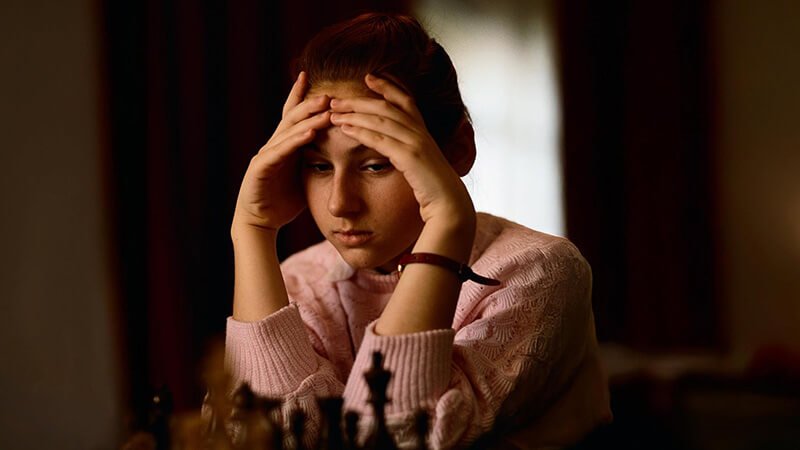
But Kennedy wisely doesn’t try to solve the puzzle of conveying the intricate challenge and beauty of chess to an unschooled audience. That’s not her goal. Queen of Chess is in fact not really so much about chess. It’s about a remarkable young woman, from a remarkable family, and her lifelong struggle against the hostility she faced trying to prove her worth in a domain dominated by men.
Veteran documentarian Kennedy tells Judit Polgár’s story in a traditional, linear fashion, starting with her father, educational psychologist László Polgár, who had a theory: geniuses are made, not born. The Polgárs’ home in Budapest, Hungary, became his laboratory. Judit, born in 1976, and older sisters Susan and Sofia were homeschooled and, starting at age 5, the vast bulk of their curriculum was chess. They spent eight or nine hours each day studying opening theory, endgame strategy, tactical motifs. No weekends, no birthdays. As László puts it, “every day was a working day.”
In 1981, six-year-old Judit won her first, amateur tournament. From this moment, she knew chess was going to be her life. “The feelings I gained from winning games, it was exceptionally powerful. After this, it was so obvious for me that I’m going to be chess player.” And she adds, with no hint of later misgivings, “Nothing else I could be.”
Queen of Chess walks you through Judit’s ascent as she and her family throw themselves against the barriers arrayed against them: a communist regime that initially prohibited them from traveling; chess events that either outright forbade participation by women or tolerated them only grudgingly; male players who resented her presence and belittled her abilities, even as she was besting them.
Slowly, persistently, like a skilled chess strategist, Judit makes headway. The breakthrough begins in 1988 when she and her sisters win an international team event, the women’s Chess Olympiad, wresting the title from the ever-dominant Soviet team. Judit received a gold medal for her performance on board 2, delivering the event’s best performance, male or female, giving up only one draw in 13 games.
After that, firmly believing that progress is possible only by challenging the best players, Judit eschews women-only events. At age 12 she begins playing in increasingly challenging professional events, often placing well, taking Grandmaster scalps. In 1991, at age 15, 4 months, she becomes, at the time, the world’s youngest Grandmaster, beating Bobby Fischer’s 33-year-old record by a month. This is not the separate “Woman Grandmaster title,” which sets a slightly lower bar. This is the title held by thousands of men and, at the time, only three other women (including older sis Susan). Becoming a GM is an extraordinary accomplishment for anyone, let alone a woman, let alone a 15-year-old, announcing to the chess world that she was for real.
By the end of her career, Judit had chalked up a series of unparalleled feats. Just to name a few: She is the only woman to achieve an international rating above 2700, the only woman to place in the world’s Top 10, and the only woman to defeat a standing world champion (more later). She won multiple prestige events and, in so doing, would defeat 11 players who would at one time or another hold the world title. Accomplishments that make her indisputably the world’s best woman player of all time.
While Judit could prove her worth at the board, overcoming attitudes was considerably tougher. At tournaments, some male players simply walked away rather than verbally resign and shake hands – an inexcusable breach of professional decorum. The venerated Grandmaster and former championship contender Viktor Korchnoi, upon losing to her, groused: “She can only beat me if I’m not interested in playing. And subconsciously I wasn’t interested today.” Journalist and International Master William Hartston is shown in an interview saying women have neither the intellectual nor emotional qualifications to excel at the game.
See It
Director Kennedy breaks no new ground in the art of documentary exposition. But the story is still engagingly told, start to finish, with some voice-over and traditional talking-head interviews of Judit and a few (it feels like too few) fellow players providing color commentary: Grandmaster Maurice Ashley and two women International Masters who point to Judit as one of their key inspirations, Jovanka Houska and Anna Rudolf. New in Chess Editor-in-Chief Dirk Jan Ten Geuzendam adds lucid historical insights.
A particular treat, even for chess veterans, is the copious volume of archival photos and video that enrich the story. The new-wave soundtrack and occasionally glaring graphics, not so much. Devoted chess players could try pausing the movie to appreciate positions being played by faceless actors’ hands, but be warned that the angles and framing are not conducive to analysis. (Just let it go; this isn’t that kind of movie.)
Kennedy hooks our interest by spending considerable time on one of Judit’s career-defining obsessions, an Ahab-like pursuit over the years of her white whale, Garry Kasparov, at the time not only the world champion but considered by many the best player of all time. In their first game, when she was 17, the infamous “touch move” infraction by Kasparov poisoned their relationship for many years, but there was an unexpected rapprochement later. Her pursuit culminates years later in their twelfth and final encounter, which Judit won convincingly.
Some artistic decisions may chafe. Most notably, the movie begins with a snippet from a 1962 interview in which Bobby Fischer denigrates women players. No knowledgeable chess player, then or now, would consider the emotionally damaged teen to be a fitting spokesman, and he was already beginning to drop from sight when Judit was born. Sticklers would also point out that Judit’s win over Kasparov was not, as we might assume, under slower, classical time controls, but a rapid format where players start with only 25 minutes for the entire game. It is still no easy task to beat a world champ at rapid, but I mention it because chess players love to quibble about details like that.
Players and non-players alike are also left wanting more. It mentions her husband, but not her two children. Both her sisters also had distinguished chess careers. Susan in particular also became a Grandmaster like Judit, and she was Women’s World Champion from 1996 to 1999. There’s not even a traditional epilogue at the end, where we might have learned why Judit retired from competitive play in August 2014, at age 38, or about her distinguished subsequent career as a coach and chess popularizer.
But movies, like chess, have a set time limit. While you come away with an appreciation of “Judit the chess player,” the film’s true goal is to introduce you to “Judit, the force of nature.” In her interviews throughout, one can’t help but be struck not only by her enthusiasm for competition but also by her objectivity. Unlike many of the male players she defeated, she easily admits when her play fell short, never criticizing, never equivocating.
For my part, I gained a new appreciation for this Super Grandmaster, since her ascendency began when I’d left the U.S. Chess Federation. What I realize now: Neither in 1983 nor today would sidebar human-interest stories about casual celebrity players generate true inspiration. Chess was on the upswing in the early 2000s, and surely got a boost when the Pandemic chased everyone inside, in front of their computers, to experience The Queen’s Gambit. Proving a point, I think: committed practitioners, even the fictional Beth Harmon, but especially the very real Judit Polgár, are the only role models whose stories can genuinely inspire dedicated players to invest themselves in the game.
In the final frames, seated in a resplendent ballroom, a chandelier above looking very crown-like, Judit is asked about being a part of her father’s experiments. She hesitates, thinks.
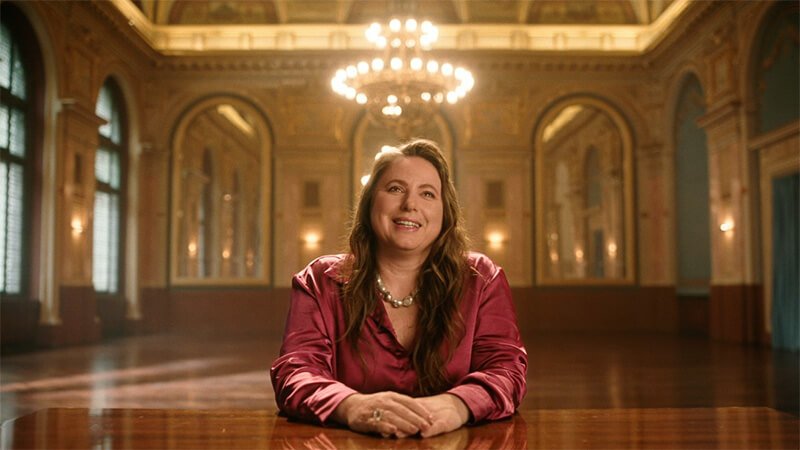
She credits 95% of her success to hard work, not genius, tacitly endorsing her father’s experiment. There is no hint of regret. Her parting advice is universal: success lies in working hard but, above all, in believing in one’s self.
Editor Ten Geuzendam sums it up nicely: “She transformed chess. She’s also a phenomenon in that sense that she was a guinea pig of her father and mother’s ideas. I think the fact that she achieved all these things that he dreamt of and that she still remained a very normal and pleasant person, that’s some sort of a miracle.”
My favorite bit?
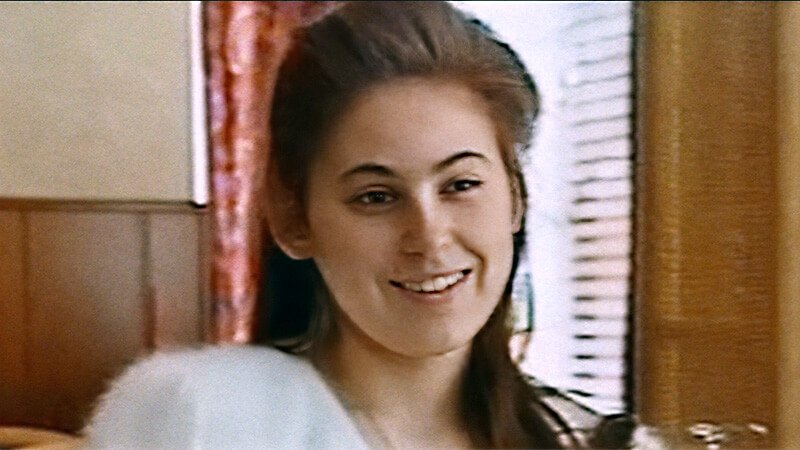
A seconds-long replay of an interview with teenage Judit, being asked, “How do male chess players respond when you defeat them?” She has no reply, no bitter recriminations. She only grins winningly, and shrugs.