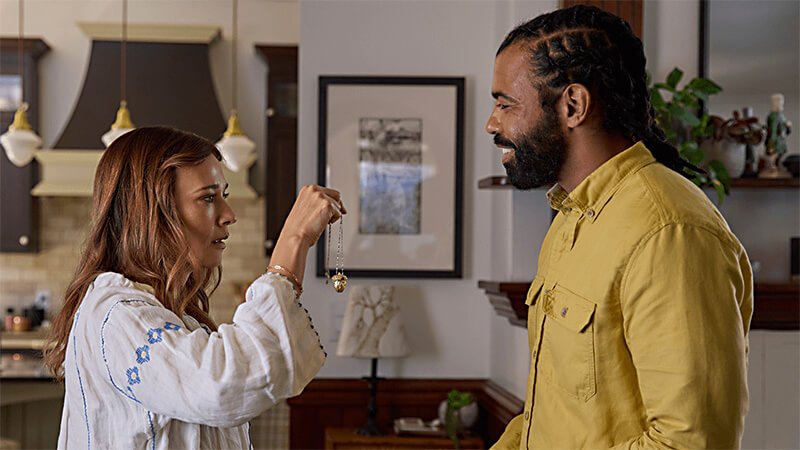
In the Blink of an Eye is the kind of movie serious critics and film snobs love to hate. It’s sentimental to the point of being schmaltzy, with uncomplicated and obvious thematic messages about the commonality of human experience throughout the ages.
It’s also touching and, yes, a tad heart-tugging at the end. I enjoyed it.
Best to get that out of the way first instead of plunging straight into the synopsis. Which is a bit of a chore to go through because it does indeed ambitiously sample human experience “throughout the ages”: the deep past, 46,000 years ago; the semi-present; and the future of 2417 and beyond.
In fact, we seem to begin at the big bang, progressing quickly through the evolution of DNA, then one-celled life, right up to what might be one of the last Neanderthal families, Thorn (Jorge Vargas) and Hera (Tanaya Beatty). They have one child, and another on the way.
Then in today’s world, anthropologist Claire (Rashida Jones) is peering deeply into the DNA of a Neanderthal skeleton that is, yes, about 46,000 years old. She’s torn between making a name for herself with her research, investing some time in her relationship with boyfriend Greg (Daveed Diggs), and wanting to care for a terminally ill mother.
The year 2417 finds us with Coakley (Kate McKinnon), a lone astronaut who is about two-thirds of the way on a 300-plus-year trip to a planet called Kepler 16b, where her cargo of frozen human embryos will be hatched to form the basis of a fresh start for humanity. Genetically altered to live long enough to survive the trip and then some, Coakley, along with organic AI Rosco, must make some desperate decisions to ensure the success of their mission.
The three timelines interweave throughout the movie, with some thematic threads that will be too obvious and on-the-nose if you’re more into Citizen Kane. Though separated by millennia, the families experience similar, universal, existential challenges. They endure hardship and setbacks and tragedy, but persevere.
See It
The screenplay is not flashy; it strives for – and achieves – a type of austere authenticity. No dramatic speeches, no clever turns of phrase, no histrionics, few platitudes. You get the feeling you’re listening to real people who struggle to articulate their feelings, as we all do. Director Andrew Stanton winds out the action and interleaving stories with an almost documentary directness that’s suited to this rumination on human persistence, adaptability, and survival. The acting is uniformly fine, and no one is trying to upstage the others. A fitting ensemble piece.
The aspect that gave me the most pause: The first two acts, which take us through the introduction of the three timelines and the challenges they face, build gradually, which is fine. But in the final third the events race downhill at a pace that’s out of step with the rest of the film. It’s almost as if the filmmakers were telling me, “OK, we’ve made our point. Let’s put a bow on it.” Still, I also found myself replying, “Yeah, got it. Nice touch, that symbol of hope and renewal at the end.” Lump in the throat. Pause a beat before taking the next breath. Got me!
If you’re naturally a cynical type – or just like the affectation of appearing cynical – then In the Blink of an Eye is not for you. All I can say is this: I see what they set out to do, and it’s a thoughtful and worthy message that I enjoyed being reminded of.