You’ll hope that you don’t understand the opening scene. Maybe the young boy’s statement is metaphorical? Surely there’s hope at the end?
But as you are pulled into this deeply moving tale of 14-year-old Seita and his 4-year-old sister Setsuko, you recognize there is no hope. It is agonizing to watch their fate unfold, and so you hang on to every joyful moment, as they do, resenting the tragedy you know is coming.
It’s March 1945 in Kobe, Japan. The world of Seita (Tsutomu Tatsumi) and Setsuko (Ayano Shiraishi) is upended when American bombers destroy their home, killing their mother. Seita shields Setsuko from the truth, and seeks shelter at their aunt’s home, hoping for the return of his father, a navy commander. As food grows scarce, the aunt’s deepening resentment goads Seita into setting up a home for himself and his sister in a cave next to a nearby pond.
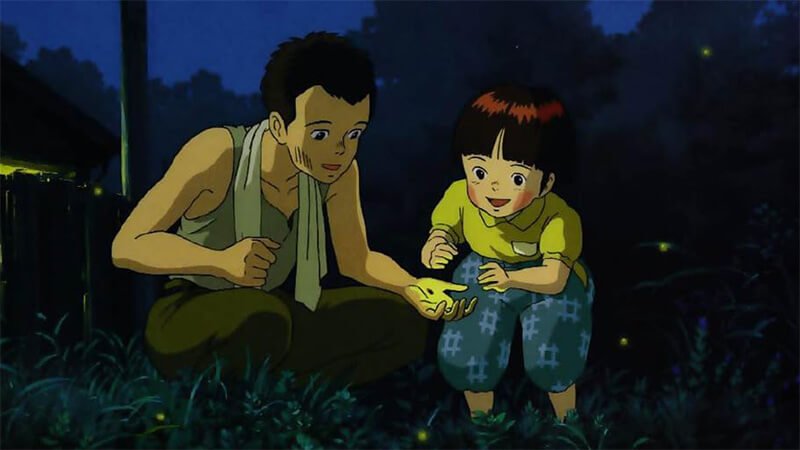
For a while, they lead an idyllic life on their own, frolicking at the shore, enjoying meals of rice porridge, capturing fireflies, rationing the few remaining bits of Setsuko’s cherished fruit candy. As they deplete their meager resources and find it increasingly difficult to get more food, Seita, single-mindedly devoted to his sister, braves air raids to plunder houses while their residents cower in shelters. Setsuko’s health begins to falter.
See It
Writer and Director Isao Takahata has stated that Grave of the Fireflies is not a political or anti-war polemic. As witnessed through the eyes of these children, the final days of the war are presented simply as a continuous struggle for survival amid the chaos of continued bombing and ever-diminishing food and resources.
The cliché “youthful innocence” is entirely too bloodless to convey the outlook of these two children, who are unequipped to imagine and adjust to the deprivations that await them. Takahata says the children’s failure is not due to the war itself but in Seita’s naïve decision to isolate he and his sister from society. Seita isn’t even aware when the war ends and, amidst all the evidence, can’t comprehend how Japan could lose.
The classic Studio Ghibli animation is by turns beautiful and haunting. Particularly affecting are tiny Setsuko’s expressions of delight, sadness, and eventual surrender. Her tiny voice echoes with longing and fear. (Ayano Shiraishi was only five when she voiced Setsuko, her only screen credit.) Even viewers like me, who normally aren’t attuned to the soundtrack, will appreciate how the lilting music amplifies the children’s joyous mood in their good times, and builds the sense of foreboding as their vulnerability grows.
At the emotional center of the movie, Setsuko buries the now-dead captured fireflies, lamenting the unfairness of their short lives and acknowledging to Seita that she knows their mother is gone. Their glowing lights had once illuminated their faces at night, magically casting their looks of joy in bright relief. But the fireflies also remind us of the burning embers of the nearby villages, and perhaps the spirits of the dead as they flicker and fade into the darkened sky above.