It’s July 1941, Tarnopol, Poland. Bombs are falling on the hospital where nurse Irena Gut (Sophie Nélisse) is working. She escapes, threading her way through rubble-strewn streets, trying to dodge advancing Germany troops. She reaches her home, only to find her mother and sisters have vanished; a German officer informs her that he lives there. She tries to elude the soldiers, but is swept up with other fleeing Poles and detained as forced labor.
Initially assigned grueling work in a munitions factory, her perseverance and German fluency catches the attention of the factory manager, Major Eduard Rügemer (Dougray Scott). Under his command, she takes on increasingly challenging assignments, first as a server in the officer’s dining room, then as an assistant in the kitchen, and then as manager of a group of 11 struggling Jewish tailors. When the major is rewarded with a villa formerly occupied by Jews, he enlists Irena to run it for him. And there the real story begins.
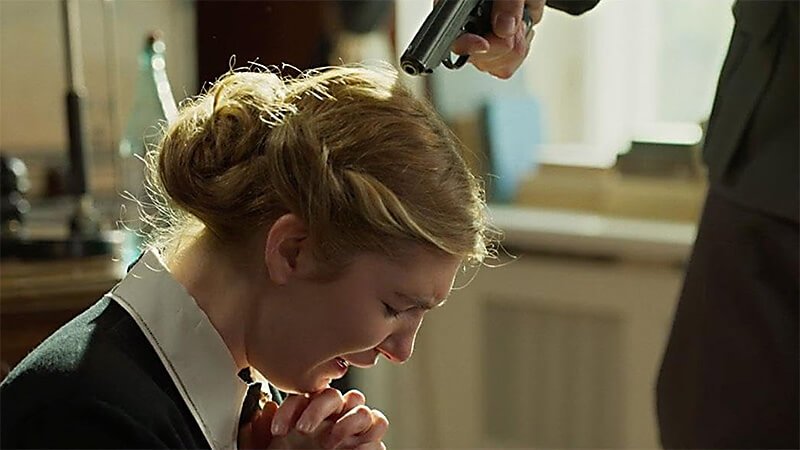
During an earlier outing to buy vegetables for the kitchen, Irena witnesses a German officer whom she serves in the dining room brutally murder a Jewish baby and its mother (a scene you might want to avert your eyes from). A devout Catholic who originally intended to be a nun, she is stunned, horrified … and transformed. When she overhears that officer’s plans to collect and dispose of the tailors, she decides she must act. She begins with no plan, but through sheer determination, and not a little luck, she spirits them away.
Were Irena’s Vow purely fiction, we’d be tempted to question the plausibility of some incidents. Indeed, the real-life drama likely differed from the tense, cat-and-mouse game director Louise Archambault has constructed. With ingenuity, courage, and unwavering commitment, Irena orchestrates a years-long quest to preserve the lives of her 11 (and later, 12) charges. Around her, relentlessly, are reminders of the unimaginably ruthless consequences that German soldiers visit not only on the Jews but also on those who dare to help them.
See It
The tale itself is absorbing, filled with fraught moments, skin-of-the-teeth escapes, and even occasional mirth and warmth. Yet it would not be nearly so engaging without the performance of Sophie Nélisse as Irena. Her impassive expressions tempt us – and her German captors – into thinking Irena a young woman who is innocent and naïve. As she faces down challenges and unexpected encounters, Nélisse’s subtly shifting expressions, from genuine shock to feigned misunderstanding, are remarkable to watch.
Dougray Scott is the counterpoint, a complicated older man who is, at once, both absolutely dedicated to succeeding in his mission on behalf of his fatherland and yet obviously unwilling to participate in his comrades’ discussions about the fate of the city’s Jewish population. Scott gives a nuanced performance as the increasingly weary and fretful Rügemer, who makes surprising decisions – though for all the wrong reasons.
Some three-quarters of a century after the close of that dark chapter in human history, there are still stories like this coming to light celebrating the bravery and self-sacrifice of people who could have looked the other way. Be sure to watch the end credits to discover how these characters fared in the succeeding years.