You know when we open on a blissful scene of a kinship – dad at the grill, warm sunset glow illuminating (mostly) happy faces; mom, dad, and kids gathering to eat at the picnic table – that it won’t be long before the hairline cracks you see in this family dynamic begin to widen. The father is Yoo Man-su (Lee Byung-hun), a successful, long-time manager at a paper mill, who loses his job when the company is sold. In this world created by director Park Chan-wook, paper-making is a passion. Man-su wouldn’t dream of finding a job in any other industry.
Man-su promises his family: three months, and he’ll have found another job in the industry. More than a year later, he’s still looking. Wife Lee Mi-ri (Son Ye-jin), having taken charge of the finances, informs her spouse they’re in danger of losing the house, his cherished childhood home. Even though she went to work as a dental hygienist (for a handsome, clingy young doctor), they can’t afford to continue lessons for their autistic but gifted cello-playing daughter. As time wears on, son Si-one lands in trouble trying to steal iPhones with a pal.
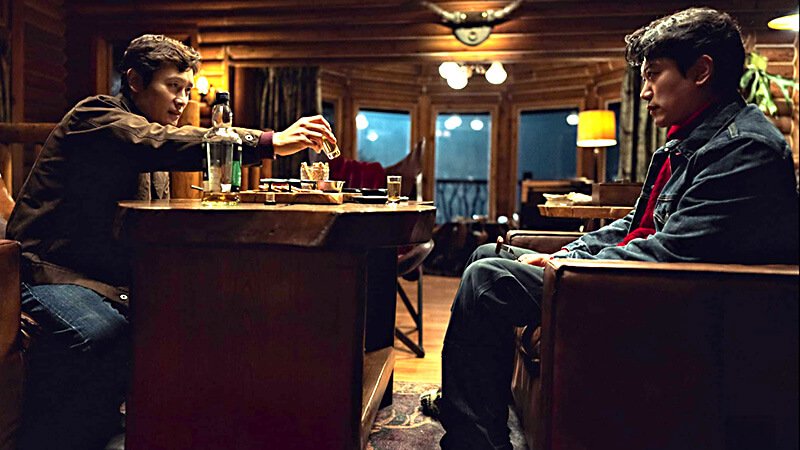
Still, Mansu doggedly clings to his dream. And then it happens: he hits upon the perfect job at a new paper company. Only there’s a problem. Actually, three problems. First, there’s the guy who currently holds the job, Choi Seon-chul (Park Hee-soon), a social media influencer. And then there are two paper-makers who would be his chief competition to replace Seon-chul: Ko Si-jo (Cha Seung-won), who is making do as a shoe salesman, and Goo Beom-mo (Lee Sung-min), who has fallen into despair over not finding a job. They have formidable resumes. What can Man-su do? Well, there is one way. It requires more nerve than Man-su appears to be able to muster. But he will see it through. He has no other choice.
See It
Give Lee Byung-hun credit. The handsome Korean superstar, featured as the dashing hero or hypnotic villain in dozens of films and series, doesn’t shrink from playing Man-su as a pathetic and weak-kneed loser. In his pursuit of, ahem, eliminating the competition, he’s clumsy and a bit dim-witted. He’s annoying when he needs to be as the petulant, discarded employee who continues making points that no one wants to hear. He evokes a smile when he threatens a family acquaintance who’s trying to throw his son under a bus, or acts foolish as the jealous husband who is probably imagining too much.
Equal credit goes to Son Ye-jin. She plays Mi-ri with the required balance. She pressures and prods her husband toward necessary action, but never berates or belittles him. And as she begins to catch glimpses of what Man-su’s really been up to, she rallies to his defense.
The three veteran actors portraying Man-su’s imagined rivals each bring unique flair to their parts: Park Hee-soon as the pedantic influencer, Cha Seung-won as the simpering shoe salesman, and Lee Sung-min as the despondent former paper all-star. Also a delight: enraged Yeom Hye-ran as Sung-min’s adulterous wife.
A distinctive plot, great performances. What’s not to like? Thankfully, this dark comedy, though it has its eye-averting moments, isn’t a gorefest. Most of the grossness is brief or implied. But the long stretches of intended comic beats between those pivotal scenes … those are going to be purely subjective. You may belly laugh at what strikes you as cleverly absurd. Me, I just chuckled at what too often landed as simply silly. Which brings us to the more regretable problem. I came away feeling director Park Chan-wook was being more than a little indulgent in the way he shoehorned in so much side action, particularly Man-su’s fumblings and misteps in his pursuit of the competition. Individually, the absurd/silly scenes bring a belly laugh or a chuckle. But altogether they begin to weigh you down and get a bit tiresome. So that when the finale comes you’re just as glad to see it all over as you learn whether Man-su gets the fate you think he deserves.