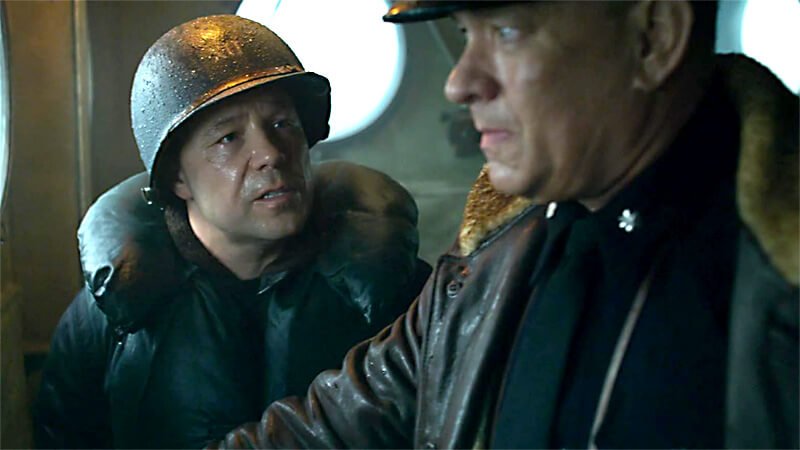
Greyhound has two unique strengths. First, while fellow movie addicts can easily cite WWII epics depicting the Battle of the Bulge or Pearl Harbor, tales of naval warfare in the North Atlantic are far less numerous. Second, Greyhound has an almost documentary feel, with scant secondary plots; it’s all about the battle.
Well, oh yeah, there’s a third: Tom Hanks.
As the opening credits roll, we get the key gist of the challenge. Once the United States joined the war effort, convoys of supply and troop ships began steaming East toward England, escorted by U.S. and Allied destroyers. Lurking in their path: roving wolfpacks of German U-boats. At the start and end of the ordeal, aircraft provided protection. But in the middle was the Black Pit, a stretch of frigid water where a convoy was on its own.
And that’s where we pick up the action, February 1942, as a convoy of 37 vessels heading East says goodbye to its air cover and begins its perilous sprint for England. Commander Ernst Krause (Tom Hanks) is at the helm of the destroyer USS Keeling, call sign Greyhound, his first combat assignment. Under his command are three other destroyers, from Britain, Canada, and Poland.
We learn nothing about the other commanders; they’re just voices on the radio. Nor do any of the crew have back stories – no ah-shucks Midwestern country boy or thickly accented Italian from Da Bronx. The most we know about Commander Krause himself is a brief flashback of him saying goodbye to a girlfriend who won’t commit to marriage. The most nuanced character is the Commander’s black messmate, who tries repeatedly to get the man to eat and rest during the ordeal.
In the coming days a wolfpack of up to five German submarines will encircle and stalk the convoy, picking off vulnerable merchant ships and dodging (or trying to) the destroyers that charge back and forth to their aid. The captain of a German sub will break into their radio to hound them. Crew members will rotate on and off duty. Krause, declining rest and food for the duration, will make life and death decisions, mistakes, lucky calls, and brilliant maneuvers.
See It
The most remarkable and compelling aspect of Greyhound is its apparent authenticity to a mode of command and combat that will seem almost antique to audiences steeped in modern action movies driven by sophisticated tech. As the sonar operator tries to discern the movement of the subs, his updates are often relayed by voice to the commander. Navigator Cole (Stephen Graham) plots a course with marker, ruler, and protractor on a glass-covered map. So many times Krause races out one door of the com, straining with his binocs to spot a target, then across to the other side for a look. He’s shadowed by a sailor whose sole assignment is to relay commands and updates to his commander. It seems a wonder that they can function at all, yet their trained coordination is reassuring.
The cinematography vividly captures the bleak, gray, frigid, wind-swept seas, the constant pitching of the ships, the close-quarter battles, the rolling turns as Greyhound strains to avoid torpedoes … and friendly merchant ships. One scene where Krause must thread the needle between two oncoming torpedoes is literally nail-biting.
Hanks, who also cowrote the script from C. S. Forester’s The Good Shepherd, turns in a predictably fine performance as the restrained and sharply focused commander who will pause momentarily to weigh a decision, correct but never criticize a crewman, or take a quiet breath for a prayer. Among the supporting cast, Stephen Graham as Navigator Cole strikes just the right tone as the officer who believes in his captain even as he is sometimes surprised by Krause’s questions and decisions.
Don’t expect grandiose speeches, daredevil maneuvers, a pomp-and-circumstance ending. Greyhound is a grounded, thoroughly authentic-feeling experience that will leave you with a new appreciation of the demanding environment in which sailors had to perform. In the closing moments, the sight of a troop carrier, hundreds of men lining her decks to salute their passing escort, reminds us of a point easy to miss in the thrill of battle: how much was at stake.